Picture logic puzzles: deduction you can see
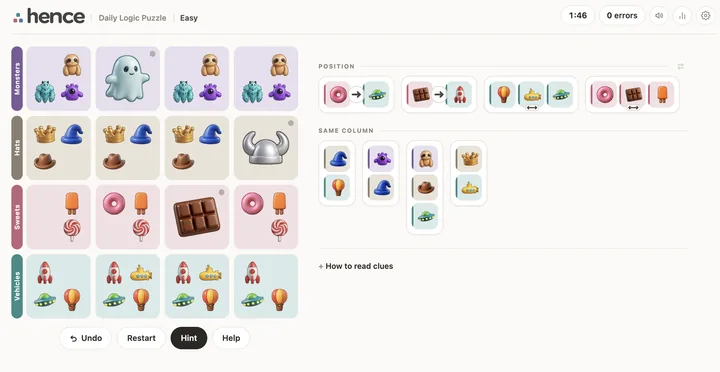
Hence is a picture logic puzzle: a grid you solve by pure deduction, where every clue is drawn in pictures instead of written in words. Here's how it works, and a tiny one to solve right now.
Try it
Each clue narrows it down.
A tiny Hence puzzle. Use the clues to figure out which picture goes where.
Your board
A new puzzle every day, the same for everyone. Monday's is the easiest, and they build through the week.
What is a picture logic puzzle?
The name gets used for two different things, so it's worth being precise.
Often it means a nonogram, also sold as Picross, Griddlers or paint by numbers. There, numbers along the edges of a grid tell you which cells to fill in, and the finished grid reveals a picture. The picture is the prize at the end.
Hence is the other kind. It's a grid deduction puzzle, like a zebra puzzle or a logic grid, where the pictures are the pieces and the clues. Each row of the board holds one kind of picture (monsters, hats, sweets and so on), and your job is to work out which column each picture belongs in. Instead of reading "the ghost wears the crown", you see a ghost tile stacked on a crown tile.
Why pictures? Because a clue you can read at a glance leaves all your attention for the logic. There's no sentence to parse and nothing lost in translation, so the puzzle is the same in any language.
The clue types
How the tiles in a clue are laid out tells you what it means. Each tile is tinted the color of its row, so you can tell at a glance where it belongs.


Stacked tiles share a column. The ghost and the crown are in the same column. A stack of three means all three share one.


Side by side tiles are about position. Here the yeti is in the column between the crown and the wizard hat, in either order.


An arrow means somewhere to the left. The popsicle is left of the submarine, however far.


A red ✕ turns a clue into its opposite. The cyclops is not in the top hat's column.
There are eight clue types in all, including next to, not next to, and a fork that means "with one of these two, but not both". The how to play guide draws every one of them.
One deduction, solved
Here's a single clue doing its work on an empty board. Nothing is placed yet, and it still rules out two squares, just from where the arrow points.






A whole puzzle is that, again and again. Each clue removes a few pictures, each removal makes another clue useful, and the board settles into the only arrangement that fits every clue. There's always exactly one, and you never have to guess.
Playing Hence
There's a new picture logic puzzle every day in two sizes: a quick 4x4 that takes a couple of minutes, and a 6x6 for a longer think. Everyone gets the same two, they get harder from Monday to Sunday, and they're free in your browser on a phone or a computer. Tap a square to see what it can still hold, tap a picture to rule it out, and tap the ✓ to place it.
Want to get better at the reasoning? How to solve logic puzzles shows six techniques on boards like these.
Frequently asked questions
Is Hence a nonogram?
No. In a nonogram you fill in cells to reveal a hidden picture. In Hence the pictures are the pieces: you use picture clues to work out which column each picture goes in.
Do I need to read English to play?
The clues are all pictures, so solving a puzzle needs no reading. The menus and the tutorial are in English.
How many clue types are there?
Eight: same column, three in a column, either-or, not in the same column, next to, not next to, between, and left of.
Is it free?
Yes. Both daily puzzles are free to play in any web browser.
Today's puzzle is waiting
A new 4x4 and 6x6 every day, the same for everyone. Free, in your browser, and you can start right away.